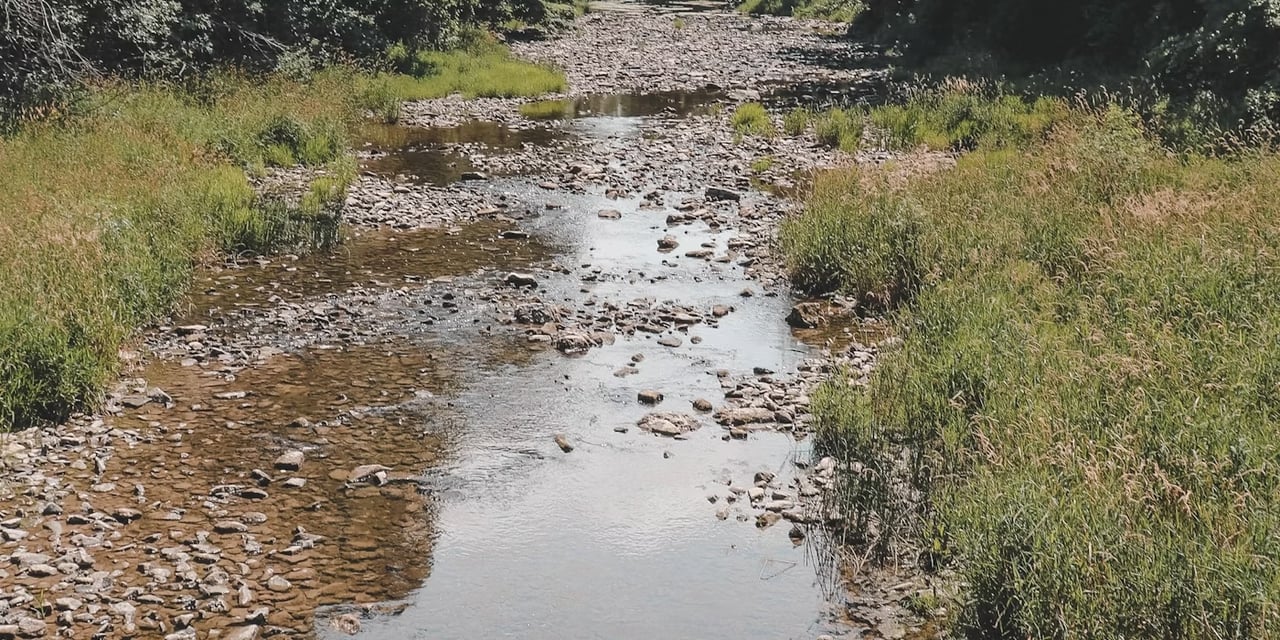
Ravine and Flood Plain Lots in Etobicoke: What You Can and Cannot Do With Them
Buyer Advice Dave Dubbin September 11, 2026
Buyer Advice Dave Dubbin September 11, 2026
You can buy one, live in one, and usually renovate one. What changes on a ravine or flood plain lot in Etobicoke is that a second approval sits on top of your building permit, held by a different agency with different priorities, and it gets a say in your addition, your deck, your pool, your regrading and the tree you wanted gone. The lot is not off limits. Your options on it are narrower, and the timeline is longer.
That is the part buyers miss. They price the view and forget they are also buying a permit process.

Looking at a property backing onto a creek or a ravine slope? Browse current Etobicoke listings, then read the rest of this before you write an offer.
Three watercourses run through Etobicoke, plus the Lake Ontario shoreline. Etobicoke Creek comes down the western edge and meets the lake at Marie Curtis Park. Mimico Creek runs through Islington and Mimico and reaches the lake at Humber Bay. The Humber River forms the eastern boundary past Old Mill and Lambton. Add the valley walls, the tableland forest above them and the treed slopes, and you have a surprising amount of the borough.
This is where it gets confusing, because two separate authorities regulate overlapping ground for different reasons.
The Toronto and Region Conservation Authority regulates under the Conservation Authorities Act and Ontario Regulation 41/24. Its concern is natural hazards: flooding, erosion, unstable slopes, wetlands and the Lake Ontario shoreline. TRCA calls the mapped area the Regulated Area, and it is the greatest extent of those features plus a prescribed allowance on top.
The City of Toronto regulates separately under Chapter 658 of the Municipal Code, the Ravine and Natural Feature Protection by-law. Its concern is trees, vegetation and grade. The City calls its mapped area a protected area, and it covers ravines, tableland forests, treed portions of the old Lake Iroquois shoreline and publicly owned parks and golf courses in valleys.
The two maps are not the same map. A property can sit in one, the other, or both.
| TRCA | City, Chapter 658 |
|---|---|---|
What it is protecting | Flooding, erosion, slope stability, wetlands, shoreline | Trees, natural vegetation, grade |
Triggers a permit | Development activity in the Regulated Area, including replacing an existing home | Injuring or removing any tree, dumping fill or refuse, altering grade |
Tree size threshold | Not its focus | None. The by-law defines a tree as any species and any size |
Appeal route | Hearing, then request the Minister review within 15 days | Community council within 30 days of refusal |
Check your address | City ravine by-law map, or the Etobicoke York office at 416-338-6596 |
Sources: Conservation Authorities Act and Ontario Regulation 41/24 via TRCA planning and permits material; Toronto Municipal Code Chapter 658, consolidated to May 12, 2022. Verified September 11, 2026.
One quirk worth knowing. Chapter 658 exempts grade changes inside TRCA's regulated area from the City fill and grading permit, because TRCA already handles that ground. Tree removal is not exempt. So on a lot inside both maps, you can end up needing TRCA for the earth and the City for the trees on the same project.
People assume the by-law is about cutting down a big oak. The list is broader than that. Under Chapter 658, inside a protected area, you need a permit to injure, destroy or remove any tree, and separately to place or dump fill or refuse or alter the grade of land. Refuse includes construction material, debris, and branches and logs that did not fall on their own.
There are exemptions, and they are narrow. Tilling a garden bed is fine as long as you are not creating slopes steeper than ten percent. Placing less than five cubic metres of soil to maintain an existing manicured area is fine. Pruning to good arboricultural practice is fine. Removing a dead, terminally diseased or imminently hazardous tree is fine, but only once the City has certified it as such, which means you call first, not after.
If you are weighing what you could build on a specific Etobicoke lot, start here:
TRCA publishes service standards, and they are more predictable than most people expect.
TRCA step | Minor application | Major application |
|---|---|---|
Decide whether your application is complete | 14 days | 21 days |
Comment or issue, after it is complete | 21 days | 28 days |
Best case, one clean round | about 5 weeks | about 7 weeks |
Source: TRCA planning and permits FAQs, verified September 11, 2026.
Read the fine print in that table. The clock runs on a complete application, and "comment or issue" means the first response can be a request for more work rather than a permit. TRCA's own process description includes pre-consultation, a site visit, circulation to technical staff, an initial set of comments, and possibly additional studies and a revised submission. Each revision restarts the second clock. A straightforward addition can land in about five weeks. A project that needs a geotechnical report and a revision or two is a season, not a month.
We do not quote TRCA permit fees here because the fee schedule is updated periodically and a stale number is worse than no number. Ask TRCA for the current schedule during pre-consultation, before you budget.
Chapter 658 is not a slap on the wrist by-law. Cutting a tree in a protected area without a permit carries a minimum fine of $500 per tree and a maximum of $100,000, plus a possible special fine of $100,000. Fill and grading offences are continuing offences, which means a minimum of $500 and a maximum of $10,000 for each day the condition persists.
Then there is restoration. Section 658-11 requires the person who did the work to replace the tree, remove the fill, regrade and restore the site to the City's satisfaction. If they do not, the City can do it and add the cost to the property tax roll. That last mechanism is the one that follows the land, which is why this becomes a buyer problem and not just a seller problem.
Where replanting on site is not physically possible, the by-law lets the City accept cash in lieu at 120 percent of its cost of replanting and maintaining the required trees for two years. Security can be required on the same 120 percent basis.
Insurance is the other approval nobody thinks about until the deal is firm. Overland flood coverage in Canada is far more available than it was a decade ago. The Insurance Bureau of Canada reported in July 2026 that 94 percent of Canadian homes can access it, with more than thirty insurers offering some form of the coverage. That also means roughly 850,000 homes nationally cannot get it.
The federal backstop that was supposed to cover the highest risk properties has not arrived. Ottawa committed $450 million over five years, the most recent target was April 2026, and as of mid-2026 there is no confirmed launch date. Those are national figures, not Etobicoke figures, and we have not seen published data isolating coverage availability street by street in this borough. So treat it as a question to answer, not a conclusion to assume.
The practical move is simple. Get a quote on the actual address during your conditional period, not after. Ask specifically about overland water, sewer backup, the deductible on each, and whether either is capped. An insurer's answer on a specific address beats any general statistic in a blog post, including the ones above.
Here is the tension, and we are not going to pretend it resolves cleanly.
A ravine lot sells at a premium in most of Etobicoke, and for good reason. You are buying a view that cannot be built out, privacy on at least one side, and a backdrop nobody can replace with a three storey infill. Scarcity is real and it is permanent, because the thing making the lot desirable is also the thing preventing anyone from adding more of them.
What you give up is optionality. In finance, an option has value even when you never exercise it, simply because you hold the right to act later. A standard Etobicoke lot carries a bundle of those rights: add a second storey, put on a rear addition, drop in a garden suite, regrade for a walkout, take down the silver maple. On a regulated lot, several of those rights are conditional on an agency saying yes, and some are effectively gone. You paid for the view with cash. You paid for it again by surrendering flexibility you may want in fifteen years.
Whether the premium exceeds the lost optionality depends entirely on the buyer. Someone who wants the house as it stands, forever, is giving up very little. Someone buying a bungalow intending to double its size is giving up a great deal, and may be paying a premium for the privilege of being told no.
We are not going to attach a percentage to that trade. We have not seen credible published data isolating a ravine premium or a regulated area discount for Etobicoke specifically, and inventing one would be worse than admitting the gap.
Two things. TRCA updates its Regulated Area mapping annually, and the data behind it was last refreshed in April 2026, so a lot that sat outside the line three years ago may not today, and the reverse happens too. And conservation authority powers have been reworked repeatedly by the province over the past few years, most recently through Ontario Regulation 41/24. If Queen's Park narrows those powers again, the constraint side of this post gets lighter. The tree by-law is municipal and moves on its own schedule.
Run the TRCA Regulated Area Search and the City ravine map on the address before the offer, not after. Both are free and take about five minutes. If either comes back yes, extend your conditional period rather than shortening it, and call TRCA for a pre-consultation while the condition is live. Ask the seller directly whether any permit, order to comply or restoration requirement has ever been issued on the property. Get the insurance quote on the specific address. And if your plan for the house involves an addition, price the possibility that the answer is no before you decide what the lot is worth to you.
All regulatory details here were verified against TRCA and City of Toronto sources on September 11, 2026. Rules change. Confirm on your specific address.
If you are looking at a property on Etobicoke Creek, Mimico Creek or the Humber, send us the address before you write. We will pull the regulated area and ravine mapping, tell you which of the two rulebooks you are under, and give you a realistic read on what you could and could not do with the house later. Sometimes that conversation ends with us telling you the lot does not support your plan, and that is worth knowing before the deposit, not after. Book a call.
Dave Dubbin
Etobicoke Real Estate Expert
Dave Dubbin & Associates
Real Estate Broker for Etobicoke and Toronto
Sotheby's International Realty, Canada
Stay up to date on the latest real estate trends.
Liberty Villiage
Etobicoke Lifestyle & Community
Liberty Villiage
Buyer Advice
Buyer Advice
Market Insight

Buyer Advice
Community Feature

Market Insight

DAVE DUBBIN & ASSOCIATES
3109 BLOOR ST W #1 TORONTO ON M8X 1E2 CANADA