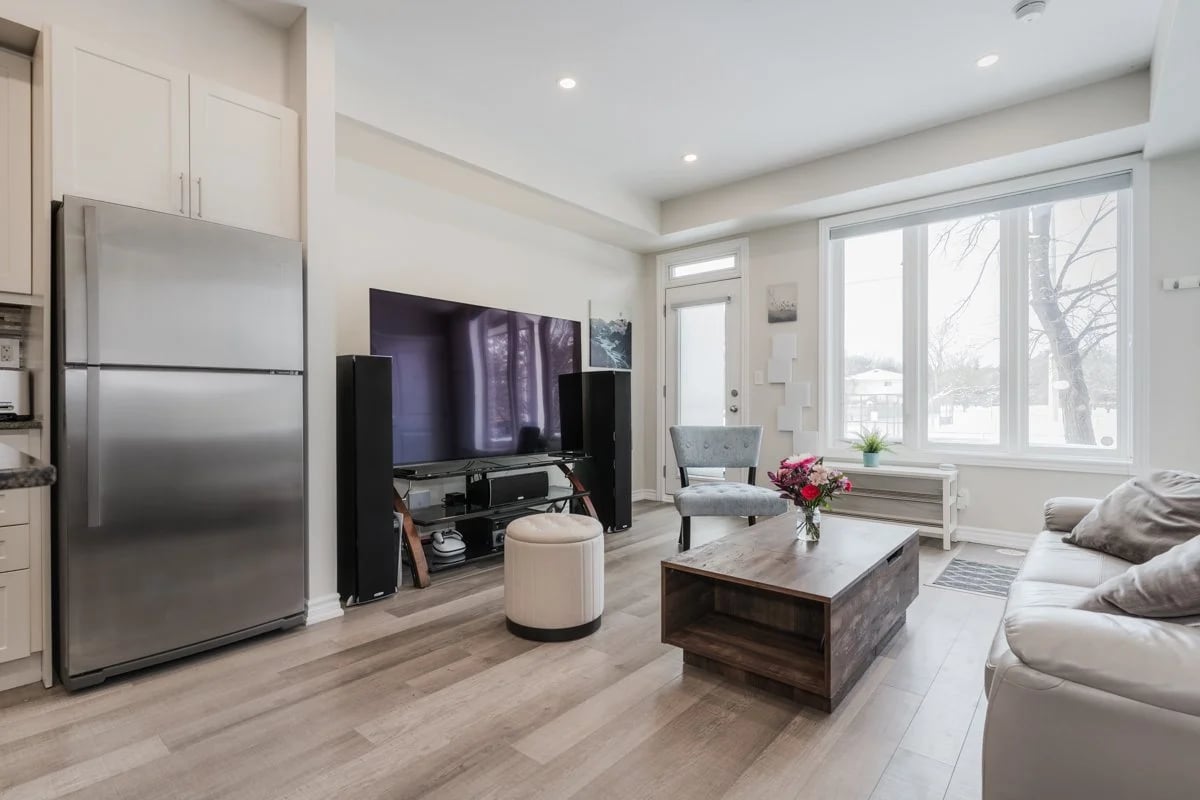
Condo Townhouses in Etobicoke: What You Get, What the Fee Really Costs, and Who They Suit
Market Insight Dave Dubbin September 23, 2026
Market Insight Dave Dubbin September 23, 2026
A condo townhouse is the cheapest way into ground-level living in Etobicoke, and in August 2026 it was cheaper than most people expect. Across the GTA, condo townhouses averaged $681,447, only about $64,000 more than a condo apartment and roughly $200,000 less than a freehold townhouse, according to TRREB's August Market Watch. The catch is the monthly fee. That fee explains most of the price gap, and whether a condo townhouse is a bargain depends on what the fee buys and how well the complex has been run.
Looking at a townhouse complex in Etobicoke and wondering if the fee is fair? Browse what is on the market now, or book a call and we will pull the numbers on the one you like.
TRREB splits townhouses into two categories, and lumping them together hides a big gap. A condo townhouse is part of a condominium corporation: you own the unit, and the corporation owns and maintains the shared parts, often including the roof, exterior walls, driveways and grounds. A freehold townhouse, which TRREB labels att/row, comes with its own piece of land and no condo corporation.
Source: TRREB Market Watch, August 2026 (released September 3, 2026). All TRREB areas. Averages mix different homes and locations, so the gaps are not the cost of upgrading an otherwise identical home.
Condo townhouses were the second cheapest category in August, sitting much closer to apartments than to freehold towns. They were also the thinnest market of the five, with 395 sales across the whole board area.
TRREB does not publish an Etobicoke-only total, so the nearest clean figure is Toronto West, the ten west-end districts that include Etobicoke's W06 through W10. In August 2026, Toronto West recorded 36 condo townhouse sales at an average of $693,331.
Area | Condo townhouse sales | Average price |
|---|---|---|
All TRREB areas | 395 | $681,447 |
City of Toronto | 120 | $712,296 |
Toronto West districts (W01 to W10, which include Etobicoke) | 36 | $693,331 |
Source: TRREB Market Watch, August 2026, condo townhouse summary table. Toronto West averages calculated from TRREB's reported dollar volume and sales. 36 sales is a small sample, so treat one month as a snapshot, not a trend.
Thirty-six sales in a month is what economists call a thin market, one where few trades happen and each one moves the average. It also makes price discovery harder. With so few recent comparable sales in a given complex, the asking price can drift a long way from what the unit is actually worth, in either direction. That cuts both ways for buyers: more room to negotiate, and more risk of overpaying if you lean on one old comparable.
If you are weighing a condo townhouse, these three are worth reading alongside this one:
Here is the part most buyers skip. A monthly fee that never ends behaves like a debt attached to the unit, and the market prices it that way. Finance people call this capitalizing a cash flow: you turn a stream of payments into a single lump-sum value by dividing the annual amount by a discount rate, the return you could earn elsewhere for similar risk.
Monthly fee | Per year | Capitalized at 4% | Capitalized at 6% |
|---|---|---|---|
$400 | $4,800 | $120,000 | $80,000 |
$550 | $6,600 | $165,000 | $110,000 |
$700 | $8,400 | $210,000 | $140,000 |
Arithmetic, not market data: the annual fee divided by the discount rate, treating the fee as a permanent payment. The fee levels are illustrative. Check the actual fee and budget in the status certificate for any unit you consider.
Put those numbers next to the roughly $200,000 gap between the average condo townhouse and the average freehold townhouse in August, and the discount starts to look less like a bargain and more like a fair trade. The market is knocking the capitalized value of the fee off the price. A buyer who sees only the lower purchase price is comparing half the cost.
The fee is not all dead money, though. Part of it goes into the reserve fund, which is the complex's savings for roofs, windows, paving and other big-ticket repairs. A freehold owner pays for those things too, just on their own schedule and out of their own pocket. So the fair comparison is the fee against what you would realistically spend maintaining a freehold townhouse of the same age, not the fee against zero.
It suits people less well if they want to renovate freely, add a suite, or hold land as the long-term investment. In a condo townhouse most of the land value belongs to the corporation, and the exterior is not yours to change.
Plenty of Etobicoke's condo townhouse complexes are decades old, and that is where the risk concentrates. A complex whose fees were kept artificially low for years may be facing roofs, windows and paving all at once, with a reserve fund that cannot cover it. The buyer who arrives just before that bill pays for years of deferred maintenance they never enjoyed. That is what a special assessment is.
There is also a middle option some buyers miss: a common elements condominium, where you own the house and its lot outright and pay a much smaller fee only for shared roads, parking or amenities. These trade and finance more like freehold homes, and they are worth asking about if you like the townhouse format but not the full condo fee.
What would change our read? If rates fall and freehold townhouses pull further ahead in price, condo townhouses may follow, which would make the current discount look like an entry point. If fees keep rising faster than inflation in older complexes, the capitalized cost grows and the discount should widen, not narrow.
Start with the status certificate and the most recent reserve fund study, not the listing photos. Look at the fee history for the past five years, the reserve fund balance against the study's plan, any special assessments already approved, and what the fee actually covers. Then price the unit against sales in the same complex and the nearest similar complexes over the past 12 months, not against the Toronto West average. With 36 sales in the whole west end in a month, the comparable set is small, and it pays to build it carefully.
A high fee matters less than whether the price already reflects it. Book a call and we will pull the status certificate numbers, capitalize the fee, and compare the unit against freehold alternatives at the same budget. If the complex looks underfunded, we will say so before you make an offer.
Dave Dubbin
Etobicoke Real Estate Expert
Dave Dubbin & Associates
Real Estate Broker for Etobicoke and Toronto
Sotheby's International Realty, Canada
Stay up to date on the latest real estate trends.
Liberty Villiage
Etobicoke Lifestyle & Community
Liberty Villiage

Buyer Advice
Buyer Advice
Market Insight

Buyer Advice

Community Feature

Market Insight

DAVE DUBBIN & ASSOCIATES
3109 BLOOR ST W #1 TORONTO ON M8X 1E2 CANADA