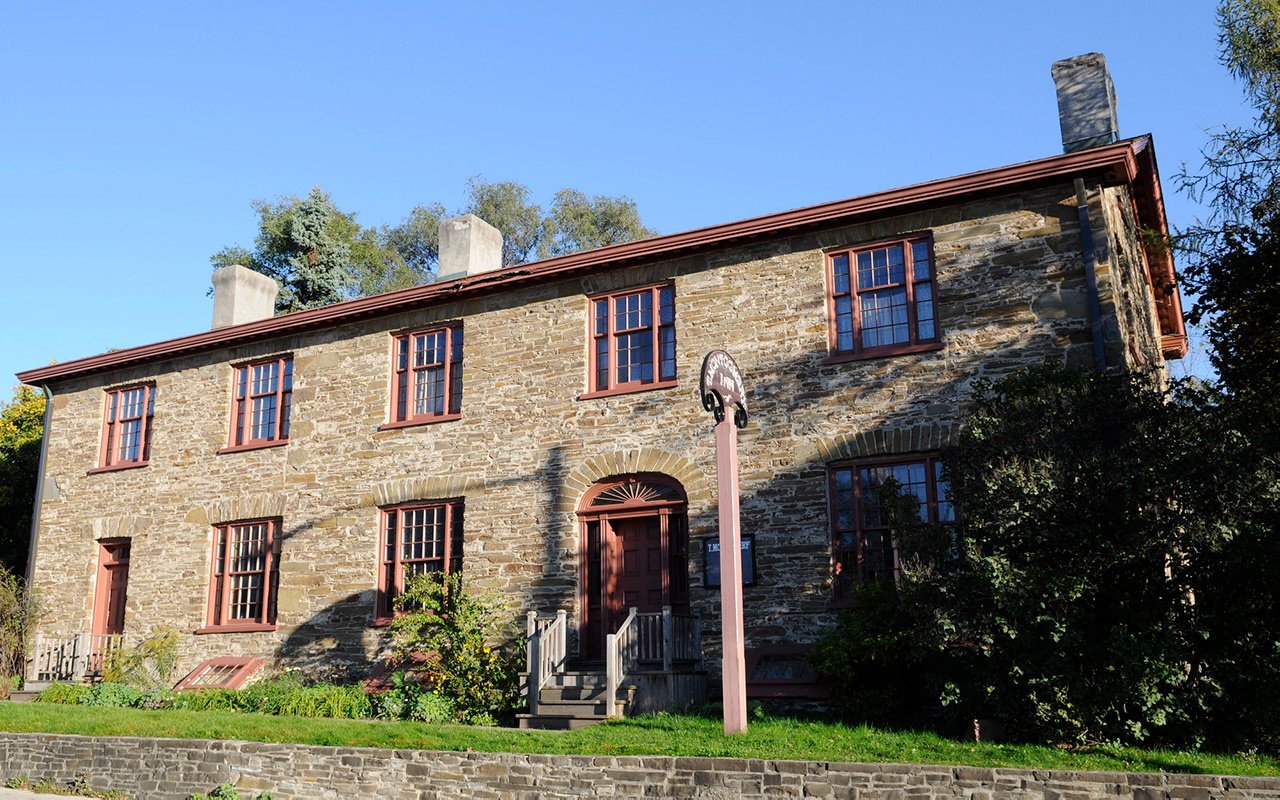
Montgomery's Inn and Etobicoke's Heritage Homes
Etobicoke Lifestyle & Community Dave Dubbin August 31, 2026
Etobicoke Lifestyle & Community Dave Dubbin August 31, 2026
Montgomery's Inn is a City of Toronto museum at the southeast corner of Dundas Street West and Islington Avenue, built in the 1830s as a stop for travellers, and it is free to walk into Wednesday through Sunday between 11 a.m. and 5 p.m. There is a farmers' market on the grounds every Wednesday from 2 to 6 p.m. That is the short answer if you came here looking for hours.
The longer answer is that the Inn is the anchor of an Etobicoke heritage story that has a deadline attached to it. The City has until January 1, 2027 to formally designate roughly 4,000 properties currently listed on its Heritage Register, or those properties come off the register and cannot go back on for five years. If you own an older house in Etobicoke, that clock is the most consequential thing on this page.
Curious what the older housing stock looks like across the west end? Start with our neighbourhood guides and we will point you at the pockets where the pre war stock actually survived.
Thomas Montgomery built the inn in the 1830s on what was then a 400 acre farm. It was designed in the Loyalist or late Georgian style: centre hall plan, symmetrical front, fanlight over the door. The walls are rubble stone that was originally covered in pebble dashed stucco and coined at the corners to imitate cut stone, which is a very 1830s way of looking more expensive than you were.
Montgomery died in 1877 and the contents were auctioned off, so the furniture you see today was donated or bought later to match what a country innkeeper would plausibly have owned. The wall colours were reverse engineered by scraping down to the original coat of paint in each room.
Twelve restored rooms, a barroom, a tea room, a hearth kitchen that still gets used, plus a modern addition with a research library, gallery and archives. Free parking off Montgomery Road, one block east of Islington. Full details are on the City of Toronto's Montgomery's Inn page.
Map drawn from OpenStreetMap data. Locations geocoded August 29, 2026.
1. Montgomery's Inn, 4709 Dundas St W. Covered above. Go on a Wednesday afternoon and do the market and the museum in one trip.
2. Applewood Shaver House, 450 The West Mall. Completed in 1852 for Peter Shaver, who had arrived from Ancaster in 1830 and farmed 200 acres west of what is now Highway 427. He hired the Weston architect William Tyrrell to build it. Red and yellow brick, Georgian, with a verandah across the front. In 1874 James Shaver Woodsworth was born in the house; he later became an MP and the principal founder of the CCF, forerunner of the NDP. The Shaver family held the property for 150 years. In 1980 the house was physically moved to its current spot in Broadacres Park, restored, and it has hosted events there ever since. Details at applewoodshaverhouse.ca.
3. The Old Mill, 21 Old Mill Rd. In 1793 John Graves Simcoe ordered a sawmill built on the west bank of the Humber, the King's Mill, which was Toronto's first industrial building. A series of mills followed on the site and every one of them burned down, the last built in 1848 by the same William Tyrrell and destroyed by fire in 1881. The ruins sat there for decades. The City declared it a heritage property in 1983, and in 2001 a hotel and spa opened on the site incorporating the original stone into the exterior walls. See oldmilltoronto.com.
4. The Lakeshore Grounds, 3199 Lake Shore Blvd W. Humber Polytechnic's Lakeshore Campus occupies the grounds of the former Lakeshore Psychiatric Hospital, which opened in 1888 and ran for 89 years. The cottage buildings sit on about 15 acres and are connected by patient built underground tunnels. Humber has been restoring them since 1991, including the 1898 assembly building, now a community theatre. The Lakeshore Grounds Interpretive Centre runs free guided tours, including the tunnels, with pre registration. Schedule at lakeshoregrounds.ca.
5. The former New Toronto Post Office, 2930 Lake Shore Blvd W. Northeast corner of Lake Shore and Islington. Completed in 1935 under the federal Public Works Construction Act of 1934, designed by Catto and Catto in a Stripped Classical style with Art Deco detailing, limestone clad with polished granite accents. City Council stated its intention to designate it under Part IV of the Ontario Heritage Act in March 2025. Staff found it met six of the nine provincial criteria, which is a lot. You cannot tour it, but you can stand across the street and see why they bothered.
If Etobicoke's older housing stock is what brought you here, read these next:
These two words get used interchangeably and they are not close to the same thing.
Listed means the property sits on the City's Heritage Register as a non designated property of potential cultural heritage value. It does not stop you from renovating. What it mainly does is trigger a notice requirement and give Council a window to react if you apply to demolish.
Designated under Part IV of the Ontario Heritage Act is a bylaw on your title. Exterior alterations that affect the identified heritage attributes need a heritage permit from the City before a building permit will issue. Windows, doors, siding, roofing, porches. Interior work is generally outside it unless the designating bylaw specifically named interior features, and routine maintenance and work not visible from the street usually fall outside as well.
Listed | Designated (Part IV) | |
|---|---|---|
On title? | No | Yes, by bylaw |
Heritage permit for exterior work? | No | Yes, where heritage attributes are affected |
Demolition | Notice required, Council can respond | Requires Council consent |
Owner can object to the status | Yes, notice of objection | Appeal process applies |
Deadline attached | January 1, 2027 for pre 2023 listings | None |
Summarized from the City of Toronto's Heritage Register Review material and the Ontario Heritage Act as amended by Bill 23 (2022) and Bill 200 (2024). This is general information, not legal advice. Confirm your own property's status with Heritage Planning before you plan any work.
Bill 23, the More Homes Built Faster Act, changed the rules in 2023. Legacy listings could no longer sit on a register indefinitely. Municipalities had to either issue a notice of intention to designate or remove the property, and once removed it cannot be relisted for five years. The original deadline was January 1, 2025. Bill 200 in 2024 pushed it to January 1, 2027.
Toronto has said openly that only a portion of the roughly 4,000 listed properties can be designated in that window. Which means two different things are about to happen to two different sets of Etobicoke owners. Some will get a notice of intention to designate and find a new constraint on their property. Most will quietly come off the register and find a constraint removed.
Designation is a restriction on your option set. In plain terms, it takes away a choice you used to have: the ability to knock the building down or radically change the front of it later. That choice has value even if you never intend to use it, the same way an unexercised option still trades for something. Take it away and, all else equal, the property is worth less to a buyer who was pricing in that flexibility.
But designation cuts the other way too. It is a credible commitment that the streetscape will not change, and for a buyer who wants a preserved block rather than a construction zone, that certainty is worth paying for. The Kingsway and Sunnylea are full of buyers who are buying the street as much as the house.
Which effect dominates depends entirely on where the value sits. On a bungalow on a 50 by 130 lot where the land is the asset and the highest value use is a new build, designation is a real cost, because it constrains exactly the thing that made the lot valuable. On a well kept 1920s house whose value is in the house itself, designation is close to free and the streetscape certainty may leave you ahead.
We are not going to hand you a percentage. The academic research on heritage designation and property values is genuinely mixed, and we have no Etobicoke specific study we would stand behind. Anyone quoting you a precise number for what designation does to a west end house is making it up. What we can tell you is which of the two situations above your property is in, and that is the question that actually decides it.
What would change our read: how aggressively the City designates between now and the end of 2026. If it moves hard, the constraint spreads and more owners find out after the fact. If it under designates, thousands of properties come off the register in January 2027 and a lot of this becomes academic.
Check the status before you write, not after. The City publishes the Heritage Register online and it takes two minutes. If the property is designated, ask your lawyer to pull the designating bylaw so you know exactly which attributes are protected, because the bylaw is the document that matters, not the general description. If you are planning exterior work, factor in the heritage permit timeline on top of the building permit timeline. And budget differently. Original wood windows, slate, and period trim cost more to restore than to replace, and on a designated property replacing may not be on the menu.
If you are looking at an older Etobicoke house and want to know whether its heritage status is a rounding error or the whole deal, send us the address. Book a call and we will check its register status, read the bylaw if there is one, and tell you what it means for what you can do with the property. Sometimes the answer is that the constraint kills the plan you had, and you should hear that before you write an offer, not after.
Dave Dubbin
Etobicoke Real Estate Expert
Dave Dubbin & Associates
Real Estate Broker for Etobicoke and Toronto
Sotheby's International Realty, Canada
Stay up to date on the latest real estate trends.

Etobicoke Lifestyle & Community

Buyer Advice
Etobicoke Lifestyle & Community

Buyer Advice
Etobicoke Lifestyle & Community

Buyer Advice

Market Insight
Buyer Advice

Etobicoke Lifestyle & Community

DAVE DUBBIN & ASSOCIATES
3109 BLOOR ST W #1 TORONTO ON M8X 1E2 CANADA