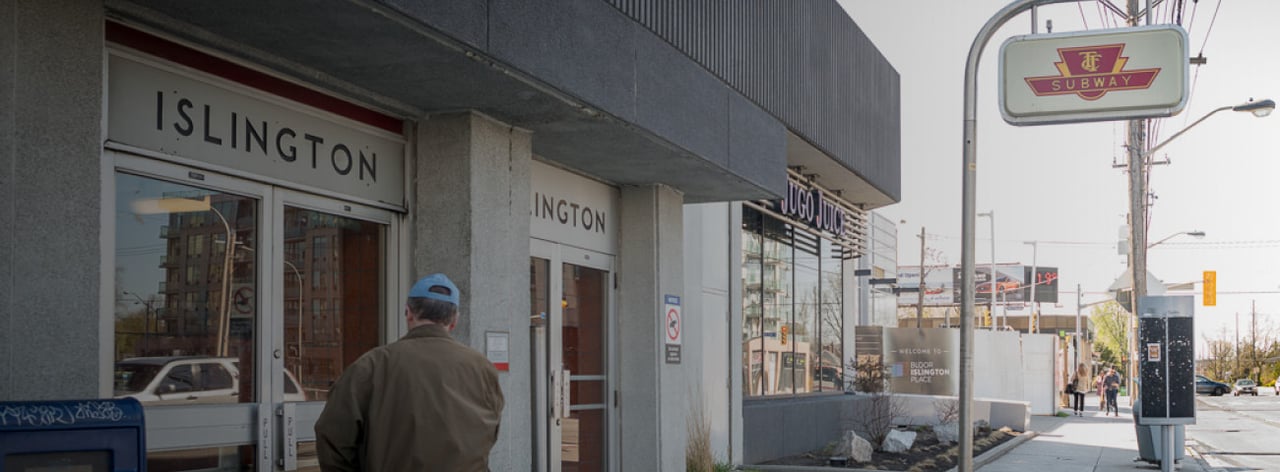
The Great Name Heist: How Islington Became Islington
Etobicoke Lifestyle & Community Samuel M May 25, 2026
Etobicoke Lifestyle & Community Samuel M May 25, 2026
If you live in Etobicoke, you probably think of Islington and Mimico as two completely different worlds. One is the heart of the Village of Murals on Dundas Street, the other a lakeside community to the south. But hop in a time machine to the mid 1800s and you'd find a very confusing situation: Islington was actually the original Mimico. Thanks to a bit of identity theft and one very indecisive town meeting, the name we know today was born.
Love a neighbourhood with a story? Get to know all of Etobicoke's in our neighbourhood guides.
Long before the subway or the high rises, the area around Dundas and Islington was a busy stagecoach stop known as Mimico, from the Indigenous word meaning sweet water. Dundas Street was the main highway for settlers moving west, and the village on the hill was a thriving little hub. Then the 1850s brought a new railway line down by Lake Ontario, and with it a real estate boom, some things never change. A second village grew at the lakefront, and when those residents applied for a post office, they snatched the name Mimico for themselves. The village that was there first lost the legal rights to its own name.
By 1858 the original village was a town with no name and, worse, no post office. Residents trekked to Lambton Mills near the Humber just to collect their mail. The locals petitioned for a post office of their own, and Thomas Musson, who owned the general store where the Second Cup stands today, was ready to serve as postmaster. The government agreed, with one rule: you can't call yourselves Mimico. That name is taken.
More west end stories:
To settle the matter, the local men gathered for a public meeting at Thomas Smith's Hotel, right where Barclay Terrace stands today. Names were suggested, arguments were had, prestige was debated, and nothing was decided. As the night wore on and the deadlock held, the group did something unexpected: they handed the choice to Elizabeth Smith, the hotel owner's wife, figuring a fresh perspective might succeed where they had failed.
Elizabeth didn't need long. She suggested her own birthplace in England: Islington. It was unique, it sounded respectable, and most importantly, everyone finally agreed. On July 1, 1860, the Islington Post Office opened inside Musson's General Store, and the identity crisis was over. The name stuck so well it eventually defined the whole stretch of the road from the lake to the northern reaches.
So next time you're sitting in traffic on Islington Avenue, remember you're travelling a road named by a homesick woman who just wanted her neighbours to stop arguing. From Sunnylea to Islington-Bloor to The Kingsway, this area has always been defined by strong community ties, and it's still one of the most sought after corners of the city, a century and a half later.
Want to write your own chapter here? Book a call with us, we know these streets and their stories.
Dave Dubbin
Etobicoke Real Estate Expert
Dave Dubbin & Associates
Real Estate Broker for Etobicoke and Toronto
Sotheby's International Realty, Canada
Stay up to date on the latest real estate trends.
Liberty Villiage
Etobicoke Lifestyle & Community
Liberty Villiage

Buyer Advice
Buyer Advice
Market Insight

Buyer Advice
Community Feature

Market Insight
DAVE DUBBIN & ASSOCIATES
3109 BLOOR ST W #1 TORONTO ON M8X 1E2 CANADA