Six Points, Five Years Later
Etobicoke Lifestyle & Community Dave Dubbin August 31, 2026
Etobicoke Lifestyle & Community Dave Dubbin August 31, 2026
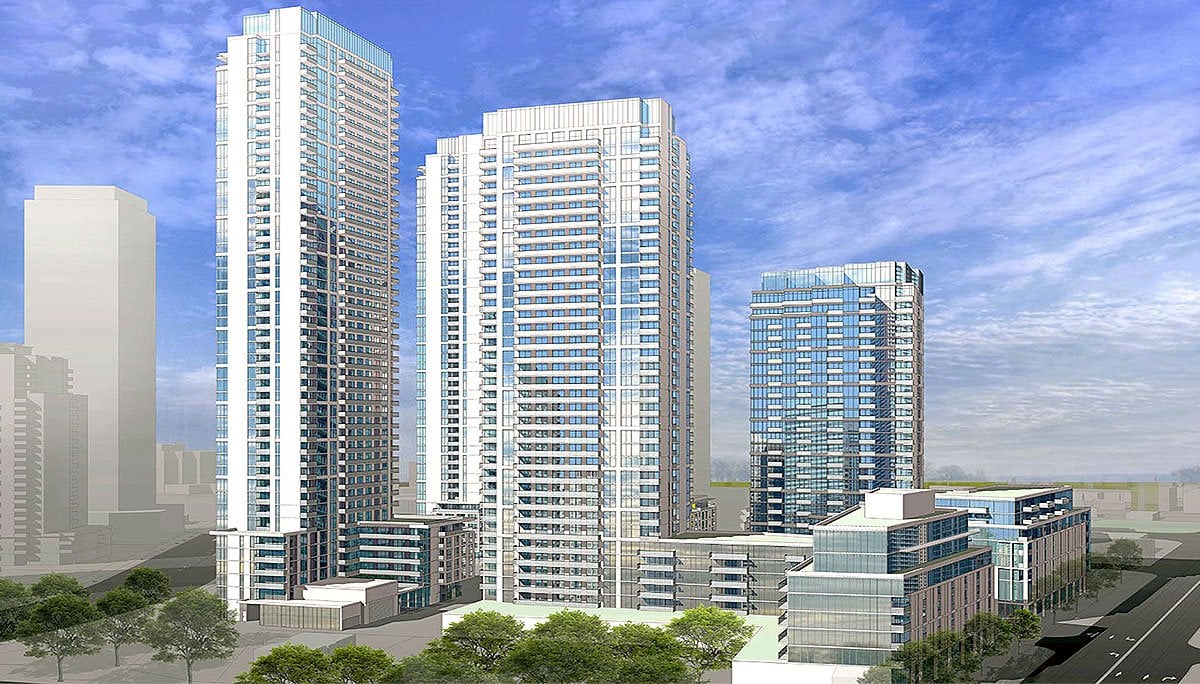
The roads at Kipling, Bloor and Dundas have been finished for five years. Substantial completion was reached in October 2020 and the City cut the ribbon in November 2021. What has not arrived yet is the neighbourhood the roads were supposed to unlock. As of the City's August 2026 construction update, the new Etobicoke Civic Centre is nine floors of concrete with structural steel going in, targeting completion in 2028, and most of the 2,700 homes planned for the surrounding blocks are still on paper. That gap between the infrastructure and the buildings is the story of Etobicoke Centre right now.
Watching this area and wondering what is actually for sale near Kipling and Bloor today? Start with current listings.
Spaghetti Junction is the name everyone used, and it earned it. Two bridges built in 1961 carried Bloor and Dundas over Kipling in a knot of ramps that nobody could walk through and most drivers could not describe from memory. The reconfiguration replaced the whole thing with an ordinary street grid.
Element | Status |
|---|---|
Two 1961 bridges over Kipling Avenue | Removed over one weekend in March 2019 |
Dundas West realigned, Bloor West extended, Kipling regraded | Complete |
Three new streets: Adobigok Pathway, Biindagen Trail, Jerry Howarth Drive | Built and named, approved December 2019 |
Separated bike lanes on Bloor, Dundas and Kipling | Complete, plus two-stage left-turn boxes at the three main intersections |
New parkland | 10,340 square metres created or planned across four spaces |
City-owned land unlocked | About 18 acres, carved into seven development blocks |
New Etobicoke Civic Centre | Under construction, completion expected 2028 |
Source: City of Toronto project pages for the Six Points Interchange Reconfiguration and the New Etobicoke Civic Centre, read August 30, 2026.
Road projects rarely pay for themselves in travel time. This one was never really about travel time. Ramps consume an enormous amount of ground for the number of cars they move, and pulling them out converted roughly 18 acres of City land from unbuildable to buildable overnight. Five of those blocks are earmarked for residential development totalling about 2,700 homes, of which roughly 900 are designated affordable rental.
The economics term for what happened is a supply shock on the land side. Supply of developable land near a subway station is close to inelastic, meaning it barely responds to price no matter how badly the market wants more of it. You cannot manufacture more property beside Kipling Station. Removing the ramps did the one thing that normally cannot be done, which is add land in a location that already had rapid transit, a GO station, MiWay buses and a kiss-and-ride at the door.
The building will replace the offices at 399 The West Mall and sits on a 13.8 acre site bounded by Kipling to the west, Bloor and Dundas to the north and the rail corridor to the southeast. It is roughly 508,000 square feet of public-facing space: a community recreation centre with two pools, a Toronto Public Library branch, a child care centre, a public health clinic, an art gallery, council chambers, municipal offices and a civic square of about 47,000 square feet.
Per the City's August 2026 update, concrete has reached the ninth floor, structural steel started going in during June, and the next stage takes concrete to the fifteenth floor while exterior cladding begins on the lower levels. Underneath it all is an Enwave district energy plant that will heat and cool the civic centre and the surrounding development blocks, which the City describes as Toronto's first near zero emissions community. Completion is expected in 2028.
More on what is being built across the west end:
Map data © OpenStreetMap contributors, tiles © CARTO.
Infrastructure raises the ceiling on what a location can eventually be worth. It does not set the floor. The floor is set by the cycle, and the cycle has been unkind. TRREB reported 1,564 GTA condo apartment sales in July 2026, essentially flat year over year, at an average price of $636,323, down 2.3%. The apartment benchmark, which is the price of a consistent typical unit rather than whatever happened to sell, was $535,200, down 7.35% year over year. Toronto West averaged $616,629 with 37 days on market. Across all housing types the GTA average was $1,003,956, down 4.5%, on 14,484 new listings, which was 17.8% fewer than a year earlier.
Read those two things together and you get the actual position at Six Points. A buyer today is paying present-day prices for a set of amenities that mostly arrive in 2028. Money has a time value, so a library, a pool and a civic square two years out are worth less than the same things next month, and the discount is real. Sellers who price as though the civic centre already opened are the ones sitting at 60 and 70 days.
The other force is the listing side. New listings across the GTA fell almost 18% year over year in July, which is what a market looks like when discretionary sellers stop trying. Fewer choices for buyers is the first mechanical step toward a floor, and TRREB's own commentary in early August pointed to a market that has tightened relative to last summer. Tighter is not rising. It is the condition that has to come first.
Three things worth saying plainly. First, drivers still complain about the new intersections, and they are not wrong that a signalised grid moves cars through more slowly than grade-separated ramps did. The trade was throughput for walkability, and if you commute by car through Kipling every morning you paid for someone else's sidewalk. Second, the 2,700 homes are a plan, not a delivery. Development approvals in Toronto have a long history of arriving late and smaller than announced, and a soft condo market is exactly the environment where blocks get deferred. Third, a district energy plant and a rec centre do not rescue pricing on their own.
What would change the read: pre-construction absorption at the Etobicoke Centre blocks picking up, the civic centre holding its 2028 date, and a real easing cycle from the Bank of Canada, which has held at 2.25% through six consecutive decisions with the next call on September 2, 2026. Any two of those three and the story here looks quite different by this time next year.
Our own read, for what it is worth, is that the land is right and the timing is early. That is usually a decent combination for a buyer with a long horizon and a bad one for anyone who needs to sell in three years.
If you are looking at a specific building near Kipling and Bloor, we will pull what has actually sold in it this year, what is sitting, and what the pipeline within a few blocks will add to competing supply before you would likely resell. Sometimes that analysis argues for waiting a cycle, and we will say so. Book a call.
Dave Dubbin
Etobicoke Real Estate Expert
Dave Dubbin & Associates
Real Estate Broker for Etobicoke and Toronto
Sotheby's International Realty, Canada
Stay up to date on the latest real estate trends.

Etobicoke Lifestyle & Community

Buyer Advice
Etobicoke Lifestyle & Community

Buyer Advice
Etobicoke Lifestyle & Community

Buyer Advice

Market Insight
Buyer Advice

Etobicoke Lifestyle & Community

DAVE DUBBIN & ASSOCIATES
3109 BLOOR ST W #1 TORONTO ON M8X 1E2 CANADA