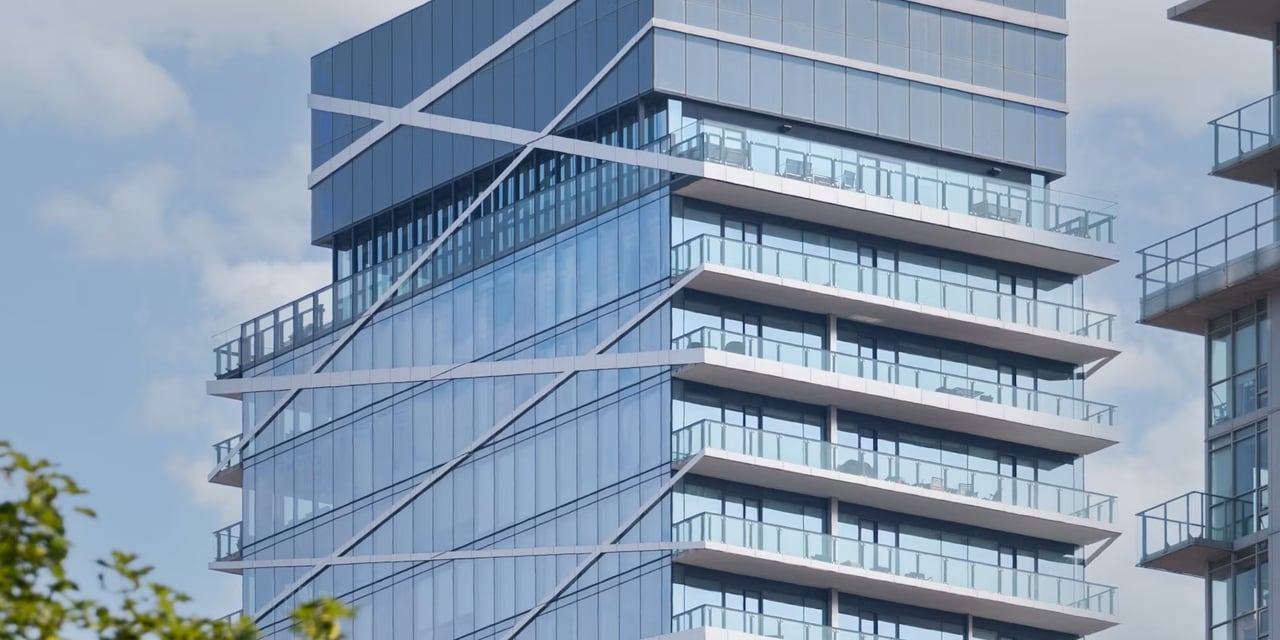
Toronto Rents Are Splitting in Two: Small Units Down, Three Bedrooms Up
Market Insight Dave Dubbin September 10, 2026
Market Insight Dave Dubbin September 10, 2026
Toronto's rental market stopped moving as one thing. The September 2026 National Rent Report from Rentals.ca and Urbanation, released September 9, shows the average asking rent in Toronto at $2,570 for apartments and condos in August, down 1.4% from a year ago. Underneath that mild number sits a split. Three bedroom asking rents in Toronto rose 3.5% to $3,642 and two bedrooms edged up 0.3% to $2,939, while nationally condo studios fell 9.3% and condo one bedrooms fell 8.9%. If you own a small condo in Humber Bay Shores or along The Queensway, you are on the losing side of that split. If you own a house with a legal second suite in Alderwood or Stonegate, you are on the other side of it.
Wondering what your Etobicoke condo or house is actually worth in today's market, rented or vacant? Get a valuation from us and we will show you both numbers.
Nationally, the average asking rent across all property types was $2,035 in August, down 4.8% year over year. That is the 23rd consecutive month of annual decline and the steepest drop since March 2026. Rents are down 7.0% over two years and sit at their lowest August level since 2022.
The interesting part is not the headline. It is the dispersion, which is the spread between the best and worst performing pieces of a market. When dispersion widens, an average stops describing anybody's actual situation.
Annual change in average asking rent, Canada, August 2026
Longer bars mean larger declines. Source: Rentals.ca and Urbanation, September 2026 National Rent Report, published September 9, 2026, covering August 2026 asking rents.
Purpose built rental buildings, the ones owned by a single landlord and constructed as rentals rather than sold off unit by unit, held up best at -3.3%. Condos were more than twice as bad. Within condos, the smaller the unit, the worse the year.
This is worth saying plainly before anyone panics. Toronto was the second most resilient of Canada's six largest rental markets in August, behind Montreal. Calgary fell 4.5% on the year. Vancouver and Edmonton both fell 4.1%. Toronto fell 1.4%.
Toronto asking rents, August 2026 | Average | Change vs Aug 2025 |
|---|---|---|
All apartments and condos | $2,570 | -1.4% |
Two bedroom | $2,939 | +0.3% |
Three bedroom | $3,642 | +3.5% |
Canada, all property types | $2,035 | -4.8% |
Ontario, apartments and condos | n/a | -3.5% |
Source: Rentals.ca and Urbanation, September 2026 National Rent Report, published September 9, 2026. Toronto rents slipped 0.3% from July.
Rent per square foot across the six biggest markets was $2.49 in August, down 2.5% on the year and down 5.2% from August 2024. The average available unit has also shrunk, from 882 square feet two years ago to 850 today. So part of the headline decline is buildings getting smaller, not just cheaper. Landlords are competing on a shrinking product.
Supply is inelastic in the short run, which is a formal way of saying you cannot conjure an apartment building in a year. What you can do is finish the ones you started four years ago. Canada is now absorbing a record volume of apartment completions, and almost all of that pipeline was designed and sold as investor product: studios, one bedrooms and one bedroom plus dens, priced per square foot for a presale buyer rather than for a family.
So the new supply landed precisely on top of the segment that had the least room to absorb it. Meanwhile nobody built three bedroom rentals at scale, because the presale math never worked for them. That is why the same report shows small condos down 9% and Toronto three bedrooms up 3.5% in the same month. Two segments, two different markets, one average pretending to describe both.
If you own or are thinking about buying an income property in Etobicoke, these are worth a read too:

Photo: Unsplash
Etobicoke's rental stock is unusually lopsided, which makes this split hit harder here than it does in most of the city. The condo inventory is concentrated in Humber Bay Shores, along Lake Shore Boulevard West and Park Lawn, in the Islington and Bloor node, and up The Queensway. That inventory skews small. A great deal of it is one bedroom and one bedroom plus den, bought presale between 2017 and 2022 by people who were told the rent would carry it.
The family sized rental supply here is a completely different animal. It is houses, mostly, in Alderwood, Long Branch, New Toronto, Stonegate and Sunnylea, plus legal second suites and the occasional older three bedroom apartment. That supply is close to fixed. Nobody adds to it in a hurry. It is a thin market, meaning few listings and few tenants at any given moment, so prices in it move on small numbers of transactions and can swing either way.
Two owners on the same street can therefore have opposite years.
Here is a worked example. The purchase price and operating figures below are assumptions for illustration, not market statistics. The anchor that is real: TRREB reported the average condo apartment sale price in Toronto West at $616,629 in July 2026, with 37 days on market and a GTA apartment benchmark of $535,200, down 7.35% on the year.
One bedroom Etobicoke condo, illustrative | Annual |
|---|---|
Purchase price (assumed) | $560,000 |
Gross rent at $2,300 per month | $27,600 |
Less vacancy and credit loss at 4% | -$1,104 |
Less condo fees at $620 per month | -$7,440 |
Less property tax | -$3,100 |
Less insurance and maintenance | -$1,400 |
Net operating income | $14,556 |
Going in cap rate | 2.60% |
Mortgage, $448,000 at an assumed 4.30% over 30 years | -$26,484 |
Cash flow before tax | -$11,928 |
Illustrative only. Rate, price, fees and rent are assumptions and will differ for every building and every borrower.
Net operating income is what the unit earns after everything except the mortgage. The cap rate is that number divided by the price, and it tells you the return the property produces before any borrowing. At 2.60% against a mortgage costing 4.30%, this is negative leverage: the money you borrowed costs more than the asset earns, so borrowing more makes the outcome worse, not better. Roughly $18,900 of that first year mortgage payment is interest and about $7,500 is principal, so the owner is buying equity at a cost of about a thousand dollars a month out of pocket.
That is not automatically a bad decision. It is a bet that rents recover and that the principal paydown plus eventual price appreciation beats the cash you are feeding it. But it should be a decision made with the number in front of you rather than a vague sense that real estate works out.
Several things could, and some of them are already in motion.
The completions wave is finite. Toronto housing starts fell 10% in July on lower multi unit starts, and CMHC expects starts to stay low through 2026 as condo development slows. Today's glut is the product of 2021 and 2022 construction decisions. The pipeline behind it is thin, which usually means the small unit market tightens again somewhere in 2027 or 2028.
Rates matter too. The Bank of Canada held at 2.25% on September 2, its seventh consecutive hold, with prime at 4.45%. If fixed rates drift down, the gap in that worked example narrows quickly. If they drift up, it widens.
The counterpoint on the three bedroom number: it is drawn from a small pool of listings, and asking rent averages move on which units happen to be advertised that month as much as on price. Rentals.ca explicitly attributed several large three bedroom moves in other markets to shifts in the mix of available units rather than real price growth. One good month is a signal, not a trend. Asking rents also say nothing about what occupied tenants pay, and Ontario's rent increase guideline caps most existing tenancies at 2.1% for 2026 and 1.9% for 2027.
Finally, the report flags a wider risk: the trade war. Direct exposure for Toronto rentals is narrow, but slower hiring and higher construction input costs would touch this market indirectly. Population growth has also turned negative, which removes demand from every segment at once.
If you own a small Etobicoke condo and it is cash flow negative, the question is not whether to feel bad about it. It is whether your basis, meaning what you actually paid and what you owe, supports holding through the next two years. An owner who bought in 2018 and has a low mortgage balance is in a different conversation than someone who closed on a presale in 2023.
If you own a house in Etobicoke with an unfinished basement, the three bedroom and multi bedroom numbers are the interesting ones. A legal second suite adds supply to the tightest part of the market rather than the loosest. That is the opposite trade to buying another one bedroom.
And if you are a tenant, the leverage is in the small units. Studios and one bedrooms are where landlords are competing. Ask for the incentive.
Every unit answers this differently, and the average asking rent for Toronto will not tell you what yours does. Send us the address and we will underwrite it properly: what it rents for today, what it would sell for today, what the cash flow looks like under both, and which one we would run if it were ours. Sometimes the answer is sell, and we will say so. Book a call.
Dave Dubbin
Etobicoke Real Estate Expert
Dave Dubbin & Associates
Real Estate Broker for Etobicoke and Toronto
Sotheby's International Realty, Canada
Stay up to date on the latest real estate trends.
Liberty Villiage
Etobicoke Lifestyle & Community
Liberty Villiage

Buyer Advice
Buyer Advice
Market Insight

Buyer Advice

Community Feature

Market Insight

DAVE DUBBIN & ASSOCIATES
3109 BLOOR ST W #1 TORONTO ON M8X 1E2 CANADA