Power of Sale or Mortgagee in Possession? The Difference, the Hidden Ones, and How Buyers Protect Themselves
Buyer Advice Dave Dubbin July 30, 2026
Buyer Advice Dave Dubbin July 30, 2026
Both are lender driven sales, and both are becoming more common across Ontario. In a power of sale, the borrower has defaulted and the lender forces the sale, but the owner usually still holds title and often still lives in the house. Mortgagee in possession goes one step further: the lender has taken over the property itself and controls it while it sells. We ran the searches on the MLS system Toronto agents use this week. Listings where the seller field literally reads power of sale: over 600 active right now. A companion search for mortgagee in possession added another two dozen. And that only counts the ones that admit it, which brings us to the hidden ones. More on that below.
Thinking about hunting in this corner of the market? Search current listings or talk to us first. This is a category where the paperwork matters more than the photos.
The short version is the renewal wave. A lot of homeowners locked in rates under 2 percent in 2020 and 2021, and those five year terms are coming due into a world of higher payments. CMHC's data shows mortgage arrears in Toronto have roughly quadrupled from their post-pandemic lows, and their renewal research flags Toronto as one of the markets under the most strain. Add soft condo values and stress in the private lending world and you get more lender sales than this market has seen in a decade.
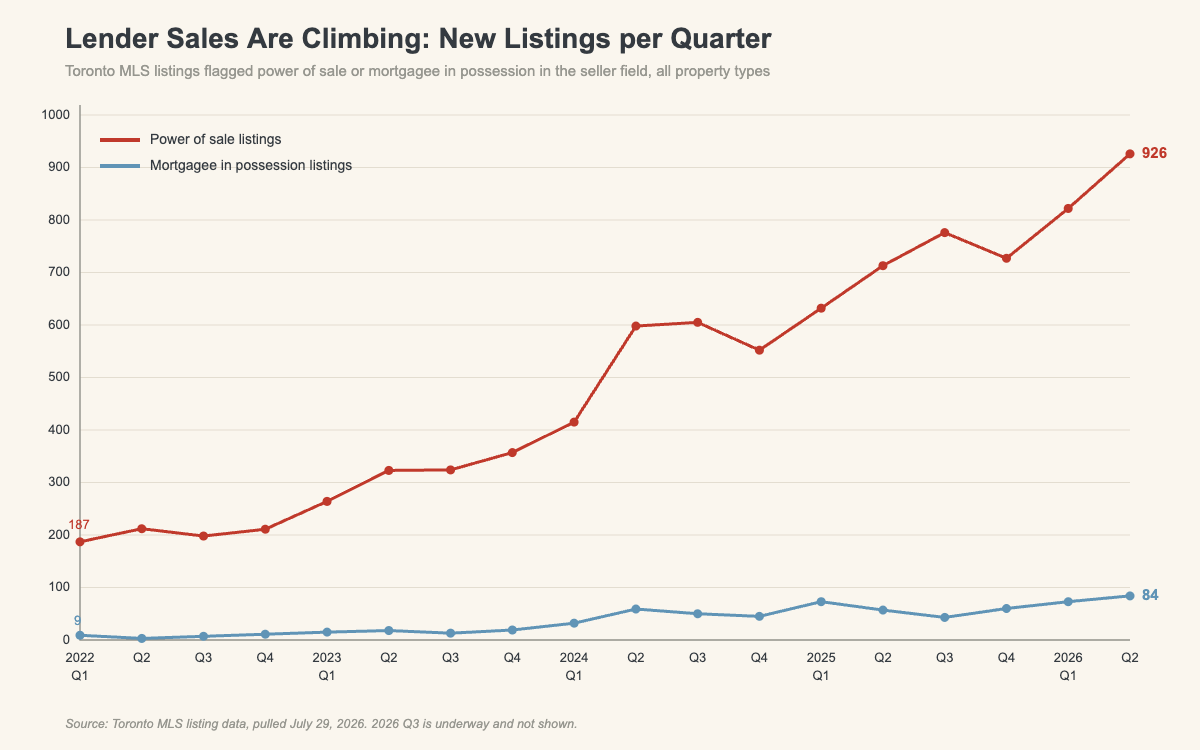
We pulled the listing data ourselves to see the shape of it. New power of sale listings have gone from roughly 200 a quarter in 2022 to more than 900 last quarter, about five times the pace. Mortgagee in possession listings are a much smaller group, but they have climbed even faster.
What this means for buyers: more distressed inventory to look at, but keep it in perspective. Arrears are still a small fraction of all mortgages. This is a growing niche, not a wave of foreclosures rolling down Bloor Street.
A power of sale is the lender's standard remedy in Ontario. The borrower defaults, the lender issues the required notices under the Mortgages Act, and if the arrears are not paid, the lender lists the property and sells it. Two things surprise people. First, the owner keeps title right up until closing, and anything left over after the debts and costs are paid goes back to them. Second, the lender is legally required to take reasonable steps to get fair market value. They cannot quietly dump the house on a friend for half price, because the shortfall or the lost surplus lands on the borrower, who can sue.
What this means for buyers: a power of sale is not an auction with a gavel and a steal of a price. It is usually a normal looking listing, priced near market, sold strictly as is, where is. The discount, when there is one, tends to be for condition and uncertainty, not desperation.
Sometimes the listing goes further and the seller is described as mortgagee in possession. That means the lender has physically taken over the property, usually because it sits empty, the owner has walked away, or the asset needs protecting. Taking possession is a bigger legal step than most lenders want. Once in possession, they take on real obligations: maintain the place, account to the borrower for every dollar in and out, and manage it like a careful owner would.
What this means for buyers: you are buying from a seller who has never boiled a kettle in that kitchen. Expect a vacant home, minimal disclosure, utilities that may have been shut off or winterized, and nobody who can tell you whether the basement leaks in April. The house may be fine. The point is that no one on the selling side knows, and the paperwork is written so that not knowing is your problem, not theirs.
We have covered this corner of the market from a few angles already:
Here is the part most buyers never hear. Plenty of lender sales never say power of sale anywhere the public can see it. The seller might show up as a numbered company or a trust company. The words might appear only in the remarks that agents see and you do not. Some say nothing at all, because the lender knows that advertising distress invites lowball offers, and their legal duty is to get market value, not to run a clearance sale.
The tells are consistent once you know them. "As is, where is." "Seller makes no representations or warranties." "Schedule B must accompany all offers." "Seller has never occupied the property." A vacant house, an oddly corporate seller name, no Seller Property Information Statement. Any one of these on its own can be innocent. Two or three together usually mean a lender is behind the curtain.
What this means for buyers: you cannot rely on the listing to announce what kind of sale you are walking into. Your agent can check the seller name field, read the broker remarks, and pull the parcel register, which shows mortgage enforcement in black and white. Five minutes of homework tells you exactly who you are really negotiating with.
The good news is that none of this is scary once you treat it as a process question. Our short list:
Sometimes. Modestly. The fair market value duty means lenders price near what comparable homes fetch, so the edge rarely comes from the sticker. It comes from thinner competition, from buyers who are scared off by the paperwork, and from condition that you can fix cheaper than the market discounts it. Run the comparables and bid on value, the same as any other purchase. The label on the seller line should change your diligence, not your math.
Found a listing you suspect is a quiet power of sale? Send it over. We will pull the paperwork and give you a straight read before you fall in love with it.
Dave Dubbin
Real Estate Expert
Dave Dubbin & Associates
Real Estate Broker for Etobicoke and Toronto
Sotheby's International Realty, Canada
Stay up to date on the latest real estate trends.

Community Feature

Market Insight

Market Insight

Buyer Advice
Buyer Advice

Market Insight

Market Insight

Community Feature

Market Insight

DAVE DUBBIN & ASSOCIATES
3109 BLOOR ST W #1 TORONTO ON M8X 1E2 CANADA