Neighbourhood Spotlight: Mount Olive-Silverstone-Jamestown
Etobicoke Lifestyle & Community Dave Dubbin August 28, 2026
Etobicoke Lifestyle & Community Dave Dubbin August 28, 2026
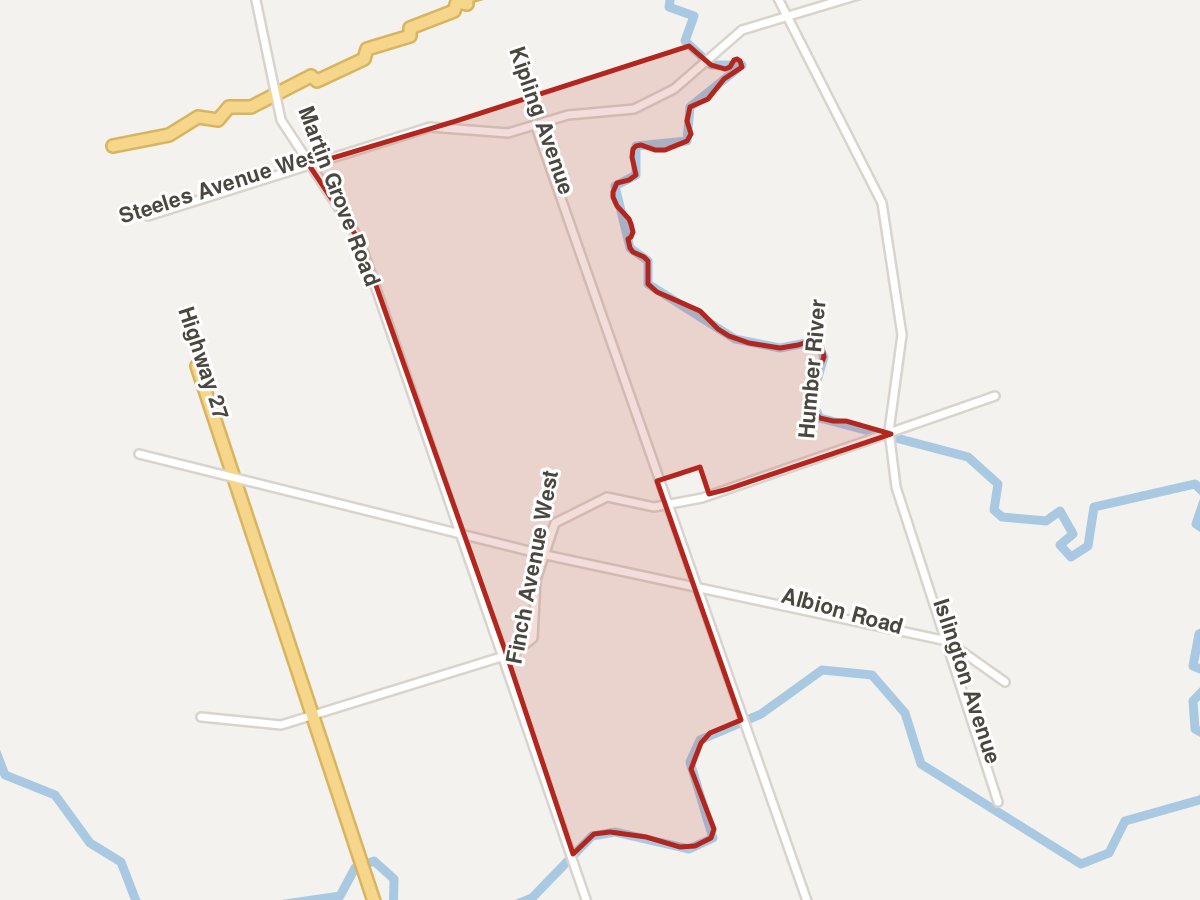
Mount Olive-Silverstone-Jamestown sits in the far northwest corner of Etobicoke, and it is probably the Etobicoke neighbourhood that gets described wrong most often. People place it around Albion and Kipling, or lump it in with Rexdale, or assume Highway 27 forms its western edge. None of those are right, and the boundary map below is the fastest way to fix that.
The short version: Steeles Avenue West is the northern edge and the Toronto city limit, Martin Grove Road runs down the western side, the Humber River forms the eastern edge, and the neighbourhood tapers to a point in the south where the West Humber River valley cuts across. Kipling Avenue runs straight up the middle of it, and Finch Avenue West crosses the southern half. Neither of those is a boundary, which is where most of the confusion starts.
Looking at northwest Etobicoke more broadly? Our neighbourhood guides cover the surrounding pockets too.
Mapped buildings inside the boundary, by type
Source: OpenStreetMap building footprints inside the City neighbourhood boundary, counted August 28, 2026. These are buildings, not homes. See the note below.
That chart needs a warning label, and it is the most interesting thing on this page. Those are building counts, not household counts. There are 2,114 mapped detached houses and 40 apartment buildings, but those 40 are towers, and a single tower holds more homes than an entire street of houses. So by footprint this reads as a detached house neighbourhood, and by population it is nothing of the sort.
We are not going to put a number on the actual split of households, because we have not verified one and a made up ratio helps nobody. What we can say from the map is that the tower clusters sit along Kipling and around John Garland Boulevard, and the detached fabric fills in behind them. If you are house hunting here, those are effectively two different markets sharing a postal code, with different buyers, different price behaviour and different liquidity.
Northern edge | Steeles Avenue West, the Toronto and Vaughan line |
Western edge | Martin Grove Road |
Eastern edge | The Humber River, with Humber Summit on the far bank |
Southern edge | The West Humber River valley, above Albion Road |
Runs through the middle | Kipling Avenue north to south, Finch Avenue West across the south |
Neighbours | West Humber-Clairville to the west and south, Humber Summit across the river |
Shopping | The Albion Centre, plus the plazas along Kipling and Albion |
Public buildings | Toronto Public Library Albion branch, Albion Arena, Elmbank Community Centre, North Kipling Community Centre |
Green space | Silverstone, Kay, Masseygrove, Garland, North Kipling, Plowshare and Highfield parks, plus the Humber valley trail system on two sides |
If you are looking at this corner of Etobicoke, the neighbouring spotlights are worth reading alongside it:
The transit story here changed materially and recently. Line 6 Finch West opened on December 7, 2025, running 18 stops from Humber College station, just southwest of this neighbourhood near Highway 27 and the 427, east along Finch to Finch West station on Line 1. Before that, getting from here to the subway meant a bus south on Kipling or Martin Grove to Kipling station, or a long ride east. Now there is a second option, and it points at a completely different part of the city.
The local bus network is straightforward: the 45 runs Kipling, the 46 runs Martin Grove, both connecting south to Kipling station on Line 2, and the 60 runs Steeles West along the top edge. For drivers, Highway 27 sits just off the western edge and the 427 and 407 are both a short run from there, which is a large part of why this corner of Etobicoke developed the way it did.
The thing worth watching is whether Line 6 shows up in prices. Rapid transit tends to capitalise into land values over years, not months, and it does it unevenly: the effect concentrates within roughly a ten minute walk of a station and fades fast beyond that. Humber College station is outside this neighbourhood, so most of Mount Olive-Silverstone-Jamestown sits past that band. Expect the effect here to be modest and to arrive through the towers along the southern end first.
We are not quoting a neighbourhood average sale price in this post. We could not verify one from a source we trust as of August 28, 2026, and neighbourhood level averages in an area with this much dispersion between towers and houses are close to meaningless anyway. An average that blends a one bedroom apartment and a detached house on a sixty foot lot describes neither.
What we can give you is the market these sales sit inside. Across the TRREB area in July 2026 there were 5,995 sales, down 0.9 percent from a year earlier, on 14,484 new listings, down 17.8 percent. The average price was $1,003,956, down 4.5 percent, and the composite benchmark was down 4.6 percent. Listings falling faster than sales is the one genuinely constructive signal in that set, because it is what has to happen first before prices stabilise.
Two buyers do well here, and they are looking at opposite ends of the same map. The first wants a detached house on a real lot within the City of Toronto, and is willing to trade a long commute for square footage and a driveway. The stock west of Kipling delivers that at a basis you cannot find in most of the rest of Etobicoke, and the lots are generous by post war standards.
The second is looking at investment math rather than a place to live. Towers here trade on yield rather than on the resale appreciation story that drives the downtown condo market, which means the numbers have to work on rent from day one. That is a more disciplined way to buy, and in a market where the GTA condo benchmark is down 7.35 percent year over year, it is also the one that has held up better.
The counterpoint, and it matters: this is a car dependent part of the city for anyone not living close to Finch, the housing stock is largely post war and will want capital, and the tower market is thin. Thin means few comparable sales, wide bid ask spreads, and a slower exit if you need one. Whatever you save on entry price you may pay back in liquidity.
If you are weighing a detached house here against something smaller further south, that is a real trade and the right answer depends on your timeline more than on either neighbourhood. Book a call and we will price both paths properly, including what the commute and the carrying costs actually come to, and tell you if we think the trade is not worth making.
Dave Dubbin
Etobicoke Real Estate Expert
Dave Dubbin & Associates
Real Estate Broker for Etobicoke and Toronto
Sotheby's International Realty, Canada
Stay up to date on the latest real estate trends.

Community Feature

Market Insight

Market Insight

Buyer Advice
Buyer Advice

Market Insight

Market Insight

Community Feature

Market Insight

DAVE DUBBIN & ASSOCIATES
3109 BLOOR ST W #1 TORONTO ON M8X 1E2 CANADA